The side table is usually the last thing anybody buys for a living room and the first thing that goes bare. I know because mine sat empty for about three weeks after Gary set it down. Every time I walked past it I felt like it was waiting on me. A round table beside a sofa takes up less than two feet of floor, but it sits exactly where your eye lands when you walk in, so an empty one makes the whole corner look unfinished even when nothing else is wrong.
Here is what I finally worked out after 30 years of pushing furniture around a three bedroom ranch house in Bowling Green. A round side table does not need much on it. It needs the right three things in the right order, and it needs the table itself to be the right height and the right distance from the sofa arm. I use the VASAGLE round side table at the window end of my sofa, and I have restyled the top of it more times than I can count. These are the five steps I actually use, in the order I do them.
The table that made my corner look finished
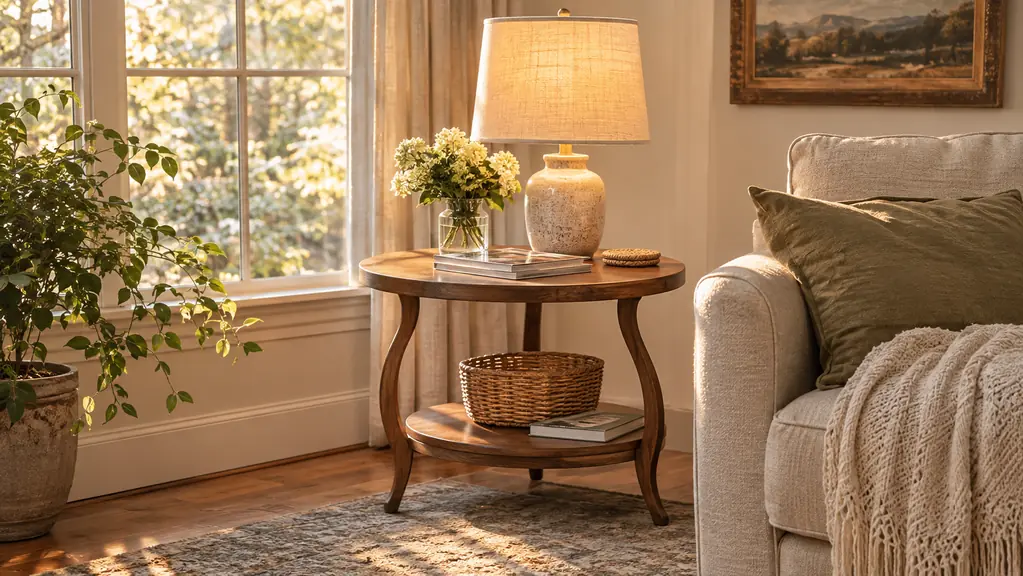
VASAGLE round side table, 19.7 inches across and 22.4 inches tall, with a second shelf that takes the clutter off the top. Gary had it together in about 20 minutes with the kit that came in the box.
Amazon See the VASAGLE Round Side Table on Amazon →Step 1: Measure the Gap Before You Buy Anything
A round side table lives or dies on two numbers: how wide it is and how tall it is next to your sofa arm. Mine is 19.7 inches across and 22.4 inches tall. My sofa arm sits right about 24 inches off the floor, so the tabletop lands a touch below the arm, which is exactly where I want it. If the table is much higher than the arm, you feel like you are reaching up for your coffee. Much lower and the corner looks sunken and you are reaching down.
The second number is the gap between the sofa arm and the table edge. You want it close enough to reach without getting up, but not pressed against the upholstery. I left a few inches of air and I can still set a glass down without leaning over. Measure your gap, write the number on the back of an envelope, and take it with you when you shop. I have bought two pieces of furniture in my life that were too big for the spot I had in mind, and both times a tape measure would have saved me the trouble.
One thing a round table gives you that a square one does not: there is no corner to catch your hip. In a small living room that matters more than it sounds. The square TV tray that used to sit there clipped my thigh every single time I walked past it, and I did not realize how often I was flinching until it was gone.

Step 2: Set It on the Rug's Edge, Not Beside It
Where the table sits on the floor matters as much as what goes on top of it. My living room has hardwood, and there is an 8 by 10 area rug under the front half of the sofa. I set the table so its front legs sit just onto the edge of the rug. That one choice ties the table to the seating instead of leaving it out on its own little island of wood.
If you have wall to wall carpet, skip ahead, but on hard floors try it. Pull the table in until at least the front legs are on the rug, then step back and look at the whole corner. It will read as one arrangement instead of two things that happen to be near each other. I move mine maybe an inch when I vacuum and I always slide it back to the same spot.
The curved legs on this table help here. There is open air under it, so the rug shows through and the corner does not get heavy. A solid box base would sit down on the rug like a little crate and stop the eye. If you are working with a small room, that open space under the table is worth more than it sounds.
Step 3: Light It First, Then Decorate Around It
If you only do one thing on this list, do this one. A lamp on the side table changes a corner more than any vase or stack of books ever will. I already owned a small table lamp and it went onto this table the day Gary finished putting it together. The table is on the window end of the sofa, so at night that whole side of the room goes from dark to warm, and the room stops feeling like a waiting room.
Put the lamp on first, turn it on, and then decorate around it. That way you are arranging things in the light the corner will actually have at eight in the evening, not in the daylight you will never see in December. I learned that with a lamp years ago that looked lovely in the store and threw a hard yellow circle on the wall in my own living room.
If you do not already own a lamp that fits, do not buy one that is too big for the surface. The top is 19.7 inches across, and a base much wider than 8 inches starts to eat the whole table. I measured my base before I moved it over. A slim base leaves room for a coaster and a magazine stack, which is the whole point of having the table there.
The tabletop is 0.59 inches thick and it sits steady under a lamp with a weighted base. Nothing flexes when you set a mug down. That sounds like a small thing until you have owned a table that flexed.
Step 4: Give the Ugly Things the Lower Shelf
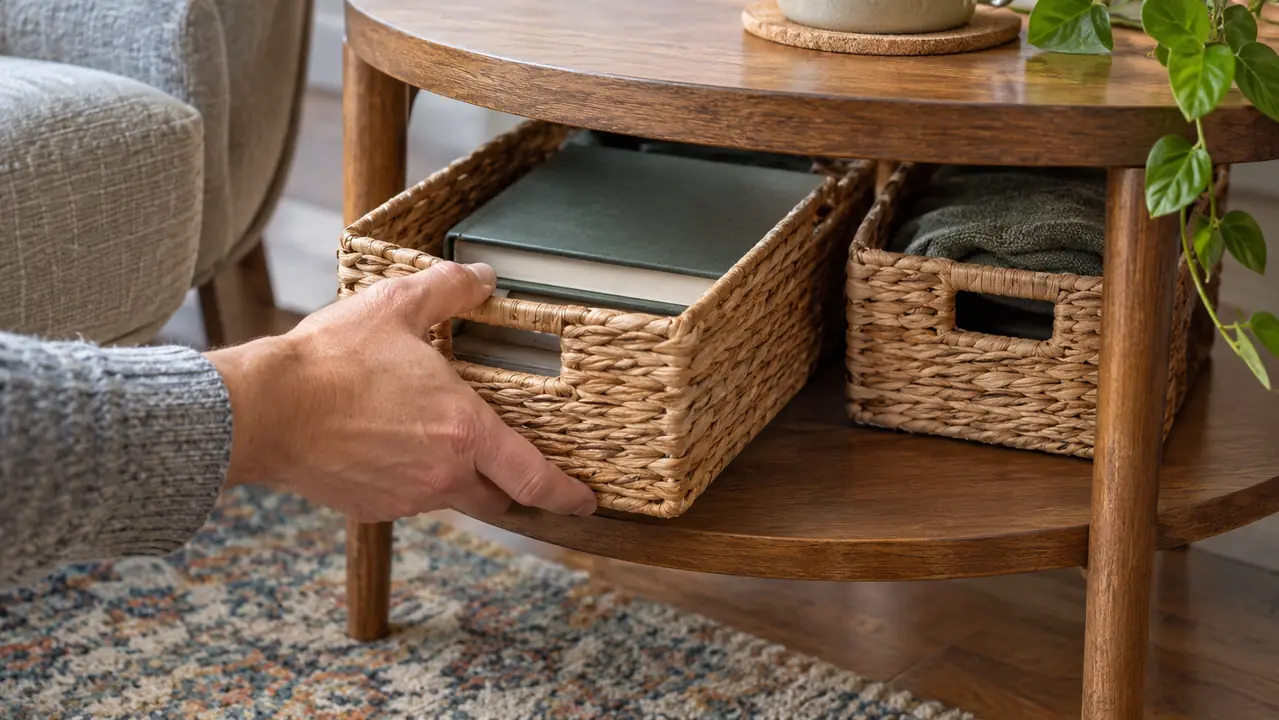
This is the part people skip, and it is the whole reason a two tier table beats a one tier table in a real house. Remote controls, reading glasses, the crossword book, a phone charger. None of that belongs on a styled tabletop, and all of it needs to live within reach of the sofa.
I keep two small baskets on the lower shelf. One holds the remotes. The other holds crossword books, a pencil, and my reading glasses. They slide in and out, and from across the room you cannot see what is inside them. The shelf is low enough that the baskets do not compete with the lamp for your attention, which was the mistake I made the first time. I used a tall bin and it looked like a little trash can sitting under the table.
The table is rated for 220 pounds across both levels, which is far more than two baskets and a lamp will ever weigh. I mention it because I have owned flimsy furniture, and the difference between a table that shifts when you lean on it and one that does not is the difference between a piece you keep and a piece you set on the curb. Gary assembled this one in about 20 minutes with the kit in the box. Fourteen months later it has not wobbled once.
Step 5: Add One Living Thing and One Flat Thing
Now you can decorate. The rule I use on any small surface is one thing that is alive or looks alive, and one thing that is flat. On mine that is a small vase or a sprig cut from the yard, and a short stack of magazines with a coaster on top.
The reason this works is proportion. A table 19.7 inches across does not have room for a big arrangement. If your vase is taller than it is wide and it is the only thing up there besides the lamp, the table looks right. Crowd it with three candles, a bowl, and a picture frame and everything shrinks, and the corner reads as cluttered even though each thing on its own is nice.
Keep the magazine stack low, an inch or so at most. Then test it the way I do: could a guest set a glass down without moving anything of mine? If the answer is no, something comes off the table. That test has never once steered me wrong, and it is the reason my table never looks like a store display.
The test I use: could a guest set a glass down without moving anything of mine? If the answer is no, something comes off the table. That test has never steered me wrong.
What Else Helps
A few smaller things that made a difference in my living room, in case you are working on the same corner.
Sit down before you adjust the lamp. The bottom of the shade should land around eye level when you are seated on the sofa, not standing. I had mine too high for a week and every time I sat down I was looking straight into the bulb. Sit, look, adjust, then sit again.
Pay attention to the sun. My picture window faces west, and from about four o'clock on, everything on that table gets strong light. That is why I keep magazines there instead of framed photographs. Behind glass, a photo turned into a mirror in that light, and I got tired of looking at my own reflection over my coffee.
Give yourself permission to change it. I restyle this table every season whether it needs it or not, and I do not buy anything new to do it. In summer it holds a jar of flowers from the yard. In winter it holds a candle and a warmer throw over the sofa arm beside it. The table does not change, only about four small things on top of it, and the room feels new each time.
The top wipes clean with a damp cloth, which matters more than I expected in a room where people set down glasses. I have wiped up a coffee ring more than once and the finish still looks like it did the day it came out of the box. Fourteen months of daily use, and I have not had to touch it up.
And the honest limits, because there are some. The VASAGLE table is a small table. At 19.7 inches across, you are not fitting a large lamp and a big stack of books on top at the same time. It weighs about 12 pounds, so it is easy to move when you vacuum, which is good, but it also means a fast-moving grandchild could shift it. If you need a wide surface, look for something bigger. If you need a table that fits the narrow gap beside a sofa, this is the size that works.
Fourteen months by the window and it still earns its spot
VASAGLE round side table, 19.7 inches across and 22.4 inches tall, with a lower shelf for the remotes and the crossword books. Rated for 220 pounds, about 20 minutes to put together with the kit in the box.
Amazon Check Today's Price on Amazon →