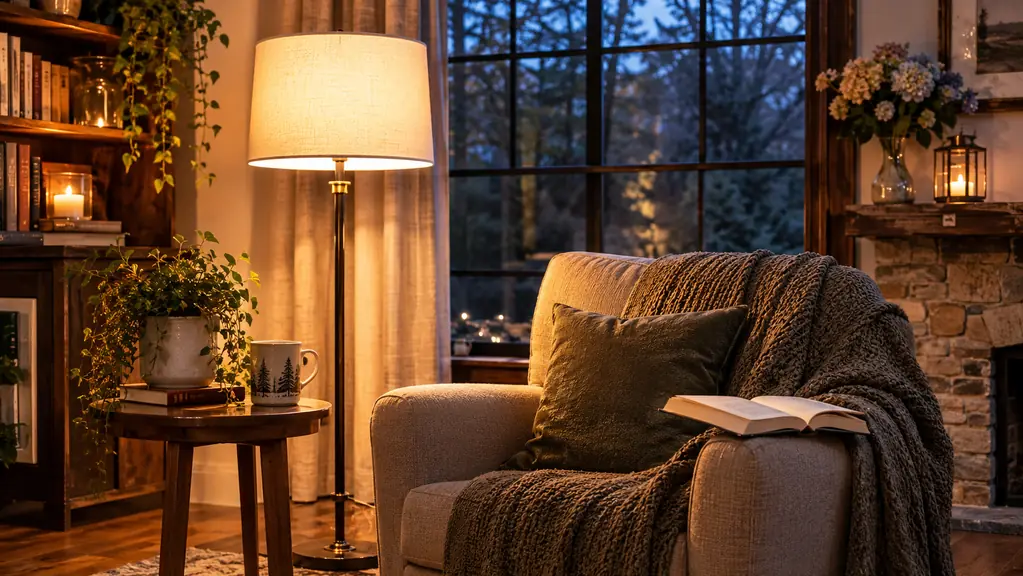
The corner of my living room between the reading chair and the bookcase was dark for eleven years. I know how that sounds. It is not an exaggeration. The big picture window on the west wall is wonderful from about two in the afternoon until the sun drops behind the trees, and then that back corner simply gives up for the night. I tried a table lamp balanced on a stack of books. I tried turning the chair. I tried telling myself the overhead fixture was enough, which it was not, because one bulb in the middle of a ceiling flattens a whole room into a waiting area. What finally fixed it was a plain floor lamp with a white shade, the Ambimall one I bought in June 2025, plus about forty minutes of actually thinking about where it should go. This is the thinking part, written down, so you can skip the eleven years.
Here is the short version before the steps. You are not shopping for a lamp. You are shopping for a light source at the right height, in the right spot, with the right bulb in it. Miss any one of those and you end up with a tall thing in the corner that happens to be turned on. Get all three and the corner stops being dark without the room looking like a furniture showroom.
The lamp that finally lit my eleven-year dark corner
Ambimall's floor lamp with the white shade and the foot pedal switch. About ten minutes to put together, no tools, and mine has stood in the same corner since June 2025.
Amazon Check Today's Price on Amazon →Why That One Corner Goes Dark
Every room has a corner the light forgets. Mine is the back one, past the sofa, where the reading chair sits with its back to the wall. Three things make it dark and only one of them is about lamps. First, no window light reaches it, not even at the height of the afternoon, because the chair and the bookcase block the path. Second, the ceiling fixture is centered in the room, so it lights the middle and leaves the edges to fend for themselves. Third, dark wood and a dark wall absorb whatever is left over. A floor lamp works in a corner like that because it puts light close to where you actually sit, at a height that reaches a book and a face instead of the carpet.
I worked this out with a spiral notebook, which sounds fussier than it was. I wrote down how the corner looked at nine in the morning, at two, at six, and at eight at night. Nine and two did not matter. Six was the problem. By eight the corner was the darkest square foot in the house, and that was exactly when I wanted to sit in it with a book. If you do nothing else before you shop, do that. It tells you what the lamp is for.
Step 1: Watch the Corner for a Full Day Before You Buy Anything
Spend one whole day looking at your corner on purpose. Not shopping, not rearranging, just noticing. When does it go dim, and is it dim in the morning and fine later, or the other way around? Does the bad hour line up with when you actually sit there, or with when the room is empty and nobody cares? I did this in July and found out my corner was only a problem after six, which changed everything about the lamp I needed. A corner that is dark all day needs something very different from a corner that is dark for two hours after supper.
The notebook also told me I had been blaming the wrong problem. I kept thinking the corner needed more furniture, when it needed one light placed low and close instead of a brighter bulb overhead. Overhead light is for finding your shoes. It is not for reading, and it is not for making a room feel like somewhere you want to stay. Once I understood that, the shopping got simple. One lamp, one bulb, one corner.
One warning about this step. Do not do it in summer and stop there, because a west window in July flatters everything. I checked again in November and the dark hour had moved up to four thirty in the afternoon. Whatever you buy has to work in the worst week of the year, not the best one.
Step 2: Measure the Corner, Not the Lamp
Now measure, and measure the corner rather than the lamp. You need three numbers: the width between the chair and the bookcase, the depth from the wall to the front of the chair, and the distance from where the lamp will stand to the nearest outlet. Mine is listed at 60 inches tall, with a base about 10.24 inches deep and 7.87 inches wide, and it weighs 5.6 pounds. In plain terms that is a narrow footprint, roughly the size of a dinner plate, which is why it slides into a gap that a side table would never fit.
Height matters more than people expect. Sixty inches puts the shade above my head when I am standing, and above eye level when I am sitting in the chair, so the light comes down over my shoulder onto the page instead of straight into my face. A short lamp in a corner throws light at your knees. A very tall one makes the corner feel like a hotel lobby. Somewhere around five feet is the friendly middle, and that is where this one sits.
Check the outlet before anything else, because this lamp is corded electric and it does not run on a battery. If your only outlet is across the room, you have a cord problem, not a lamp problem, and it is much better to find that out while you are still deciding than on the day the box arrives. In my living room the outlet sits behind the chair, so the cord drops down and back and I never see it.
Step 3: Put It Together on an Ordinary Afternoon
Put it together on a Tuesday, not twenty minutes before guests arrive. The Ambimall arrived in one box with the shade, the stand, and a user manual. The listing says ten minutes with no tools, and that was true for us. Gary handed me pieces and I screwed the sections of the pole together, set the shade on top, and tightened the last ring. No screwdriver, no Allen wrench, nothing to hunt for in the kitchen drawer.
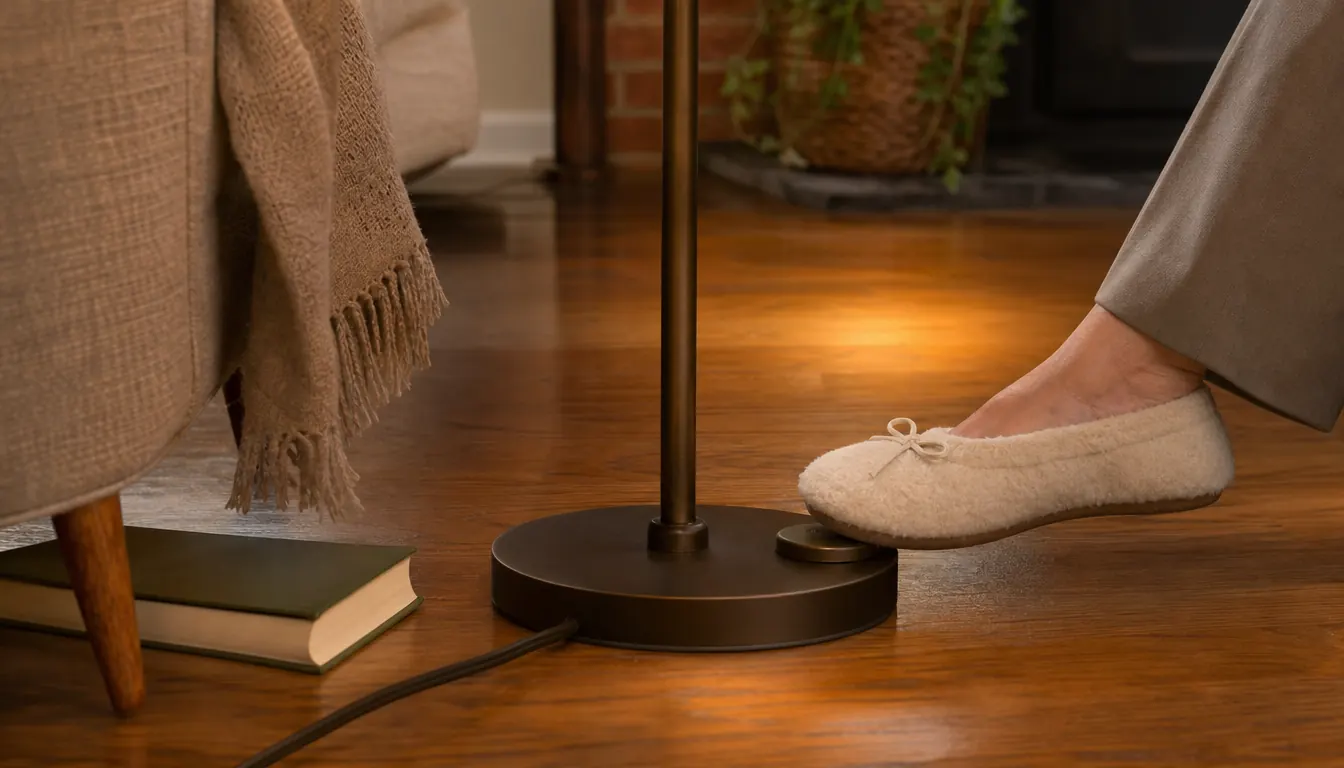
Then test it in the middle of the floor before you commit it to the corner. Plug it in, tap the pedal, and make sure the light comes on. The switch is a foot pedal, plain on and off, so you work it with your shoe. That is the whole control panel. There is no dimmer, no remote, no timer, and no app, which I want to say plainly up front, because a lamp with a pedal switch is a different animal from a lamp with settings.
This is also the moment to think about where that pedal ends up. Once the lamp is against the wall behind a chair, you want to reach the switch without standing on your head. Set the lamp down, sit in the chair, and see whether your foot finds it naturally. If it does not, move the lamp six inches before you get used to being annoyed, because being annoyed is what makes people stop using a lamp they paid for.
Step 4: Get the Bulb Right, Because It Does Not Come With One
The lamp does not come with a bulb. What it takes is a standard E26 base bulb, the ordinary screw-in kind, and the listing recommends a 2700K warm white. I bought mine separately, one LED bulb, and I am glad I did, because in a corner lamp the bulb matters more than the lamp does.
2700K means warm. Think of the light in a hotel lobby at night, or a good table lamp in a den. It makes wood look like wood and skin look like skin. A cool white or daylight bulb in a corner lamp makes the whole room look like a break room at an office. I made that mistake in the first week because it was the bulb already in the kitchen drawer, and I lasted two evenings before I ordered the warm one.
Wattage is the other half of it. The lamp is listed at 6 watts, so match the bulb to that and do not drop a hundred watt bulb in because you want it brighter. Brighter is not the goal. The goal is a pool of warm light exactly where you sit, with the rest of the room a little softer.
Step 5: Place It, Then Move It Twice
Set the lamp down beside the chair, not behind it and not in front of it. My first try had it a foot too far back and all I got was a bright patch on the wall. The second try had it too close to the arm of the chair, and the shade sat right at my shoulder, which meant I could see the bulb every time I turned a page. The third try, two inches further into the corner and tipped slightly toward the seat, was the one. Expect to move it twice. That is normal, and it is why you should not throw the box away the same day.
Then look at the room, not at the lamp. Turn the overhead light off and see whether the corner now reads as part of the room or as a spotlight. In my house the difference was mostly about the wall behind the chair. Once the lamp was close enough to the wall, the light washed up it and the whole end of the room warmed up. When it was too far out into the floor, the wall stayed dark and the lamp looked stranded out there by itself.
There is no dimmer on this lamp, no remote, no timer, no app. If the light is too strong at nine at night, the answer is a different bulb, not a setting.
What Else Helps
Light is most of it, but three other things did the rest of the work in my corner. The first was a small round side table beside the sofa, about 19.7 inches across, which gave the lamp some company and stopped the corner from looking like one lonely pole. The second was swapping the little table lamp I already owned to a warmer bulb, so the two lights matched instead of fighting. The third was keeping the floor clear. A corner reads brighter when your eye is not tripping over a basket and a pair of shoes.
What did not help: a second bright lamp, which made the corner feel like a dentist's office, and string lights, which I tried one December and took down in January. A mirror in a dark corner is a daytime trick. It bounces window light around beautifully at two in the afternoon and turns into a black rectangle after dark, so do not count on it to solve an evening problem.
One practical note before you commit. If your corner is a walkway, put the lamp where nobody has to step around it all evening, and check that the cord lies flat against the wall. A floor lamp that people dodge on the way to the kitchen is a floor lamp that ends up in the garage by spring.
When a Floor Lamp Is Not the Right Answer
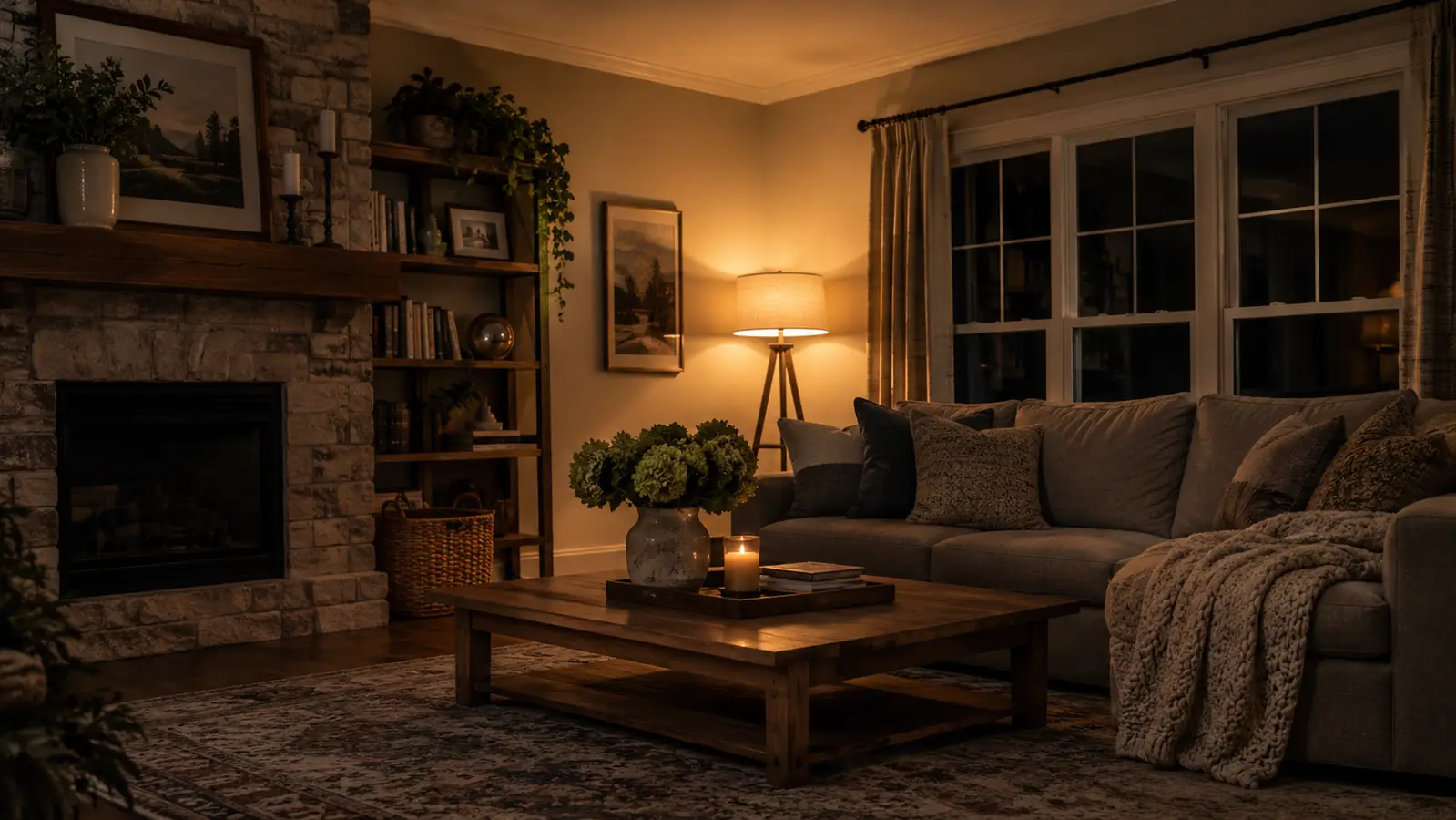
I want to be straight with you, because not every dark corner needs a floor lamp. If the corner is the path between the kitchen and the front door, a lamp there will be in the way and you will resent it. If the only outlet is behind the sofa on the far wall, you are looking at an extension cord across the living room floor, and I would rather you buy a small table lamp than live with that. And if the corner is dark because the walls are dark and the furniture is dark, one lamp will light the chair but it will not light the room.
What a floor lamp does well is exactly one job. It puts warm light at sitting height in a spot the ceiling fixture cannot reach. It is not a renovation and it will not fix a room with no overhead light and one outlet. But for the ordinary case, a chair, a book, and a corner that goes dark at six, the simplest fix I know is a plain lamp in the right spot with a warm bulb in it.
If your corner looks like mine did at eight in the evening
Ambimall's floor lamp, white shade, foot pedal switch, E26 base, no tools and about ten minutes to assemble. One bulb, bought separately, is all it needs.
Amazon Check Today's Price on Amazon →