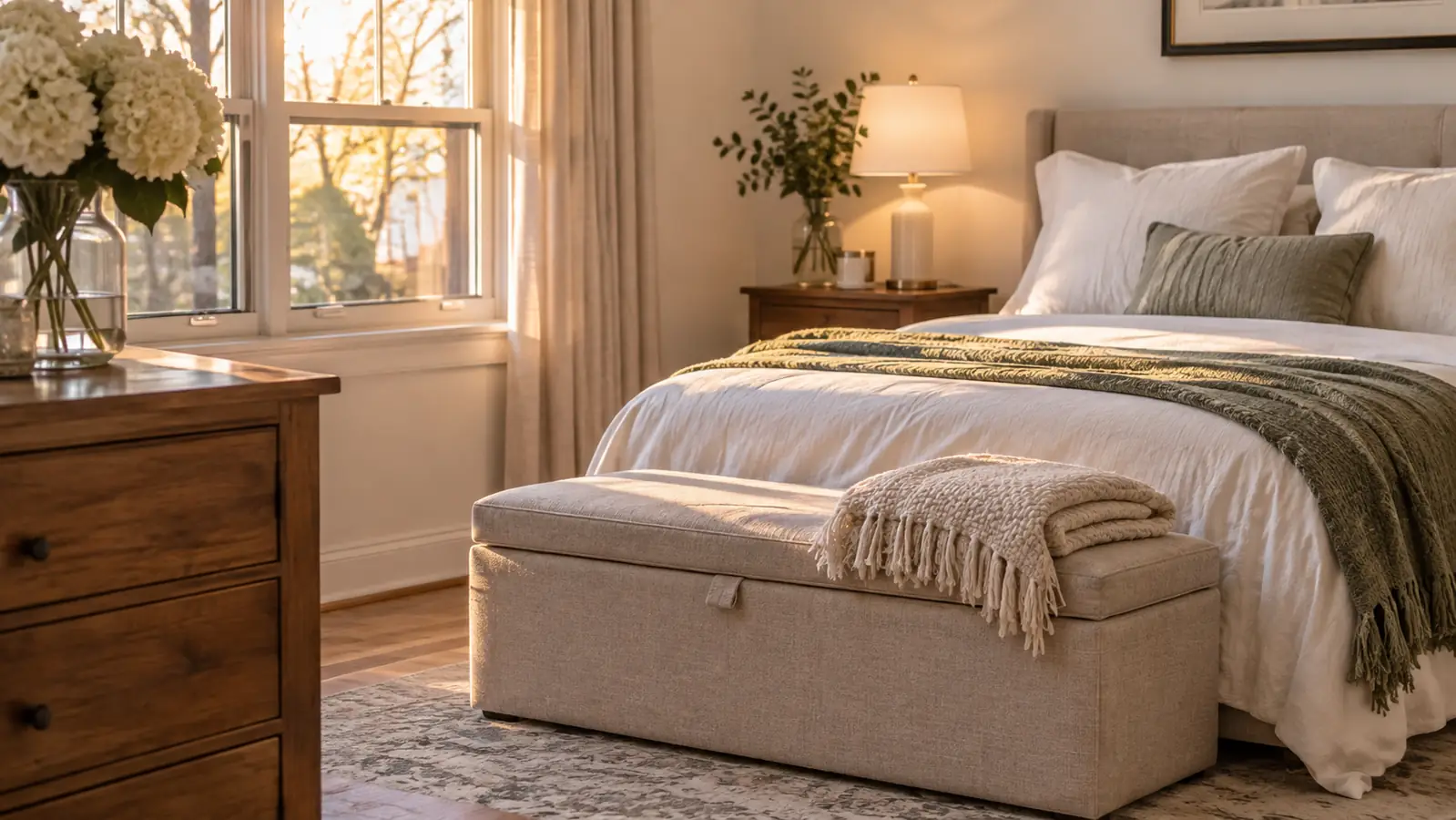
For about a year, every flat surface in my bedroom had a job it was never meant to have. The chair in the corner held the sweater I might wear. The foot of the bed held the tote bag I might need. The top of the dresser was a graveyard of receipts, hair ties and one earring. What I did not have was one honest place to sit down and put my shoes on in the morning.
I fixed it with a storage ottoman bench, and I will be honest with you: the bench was the easy part. The SONGMICS folding storage ottoman bench opened out in about ten seconds, no tools, no cussing, no waiting on Gary to bring his drill in from the garage. What took me the better part of two weekends was figuring out how to use it so the clutter actually stayed gone instead of just moving five feet to the left. Here is the order that worked in my house, and I would do it in that order again.
Your bedroom chair is not a closet. This is.
The SONGMICS folding storage ottoman bench is 43 inches wide, 15 inches deep and 15 inches high, with 31.7 gallons of space under a lid reinforced with metal corner guards and rated to hold 660 lb. It opens out in seconds with no tools.
Amazon Check Today's Price on Amazon →Step 1: Measure the floor space before you fall in love with a bench
Before you buy anything, measure the empty floor you are planning to take over. I used Gary's tape measure at the foot of our bed and wrote the numbers on the back of an envelope: about 50 inches of wall between the dresser and the closet door, and 14 inches of walkway I was not willing to lose. That envelope kept me from ordering a bench that would have made the room feel tighter than the clutter did.
There are two measurements that matter and most people only take the first one. The width is the obvious one. The depth is the one your shins meet in the dark. A deep chest looks generous in a photo and then eats the walkway in a real bedroom, and you end up sidestepping it every night. The bench I bought is 43 inches wide, 15 inches deep and 15 inches high, and it sat on that 50 inch wall with room to spare. The fifteen inch depth is what sold me, and I also checked the height against the mattress, because a bench that stands taller than the foot of the bed reads like a wall from the doorway. Ours sits a touch lower, which keeps the room looking open.
One more measurement people forget: the door swing and the dresser drawers, not just the wall. Our dresser sits on the same wall, and I got down on the floor and opened the bottom drawer to be sure it would clear the front of the bench. It clears by about an inch and a half, and only because the bench is shallow. A deeper piece would have meant opening that drawer sideways for the rest of my life. It looks silly to do on your bedroom floor. Do it anyway.

Step 2: Empty the mess onto the bed and sort it into three piles
This is the part nobody wants to do, and it is the part that decides whether the bench works at all. I took everything off the chair, off the bedpost and off the dresser top and dumped it in one pile on the bed. It looked worse before it looked better, and that is normal.
Then I sorted it into three piles and said each one out loud, because saying it keeps me honest. Pile one was things that live in this room: a throw blanket, four sweaters out of season, a shoebox of sewing patterns. Pile two was things that live somewhere else and had simply drifted in: mail, a library book, two coffee cups. Pile three was things I did not need at all, and that pile filled a grocery bag before I was done.
Have a bag and a box ready before you start, because otherwise pile three ends up back on the chair while you hunt for somewhere to put it. Mine was a grocery bag for the bin and a cardboard box for the donation center. The box sat by the front door for a week, which is normal, and then it left.
Pile two went where it belonged that same afternoon. Only pile one was allowed inside the bench, and that rule is the whole method. A storage bench is not a place to put off a decision. It is a place for things that already have a home and just needed a better one.
Step 3: Pick a bench that will hold the pile you actually have
Now that you know what has to go inside, you can stop guessing at sizes. My pile was one throw, four sweaters and a shoebox. That is not much, and it told me I did not need the biggest bench on the page. Along the way I passed on two others. One was a big wooden storage bench with a hinged top, beautiful and heavy as a piano, and I knew I would never move it once it landed. The other was a deep fabric chest, and the depth was the problem I already told you about. Neither was a bad piece of furniture. They were bad fits for a bedroom with 14 inches of walkway, and that is a different thing.
Three things on the listing decided it for me. The first was the fold. It arrives folded flat and the base and lid open out, which is why there was no line of screws and little wrenches on my bedroom floor. The second was the inside, 31.7 gallons of space, more than twice what my pile needed, so nothing has to be jammed in and then fought back out. The third was the lid. It is built with MDF panels and reinforced with metal corner guards on the lid, and the listing rates it to hold 660 lb. I am not going to test that with a bowling team, but it means I sit on it every morning without thinking twice.
The outside is a linen look fabric with a tufted top, and it reads like furniture instead of a container. That mattered to me more than I expected it would. A storage box you can see is a storage box sitting in the middle of your bedroom. A bench at the foot of the bed is a bench, and what is inside is nobody's business but yours.
A storage bench is not a place to put off a decision. It is a place for things that already have a home and just needed a better one.
Step 4: Divide the inside so you are not emptying it to find one thing
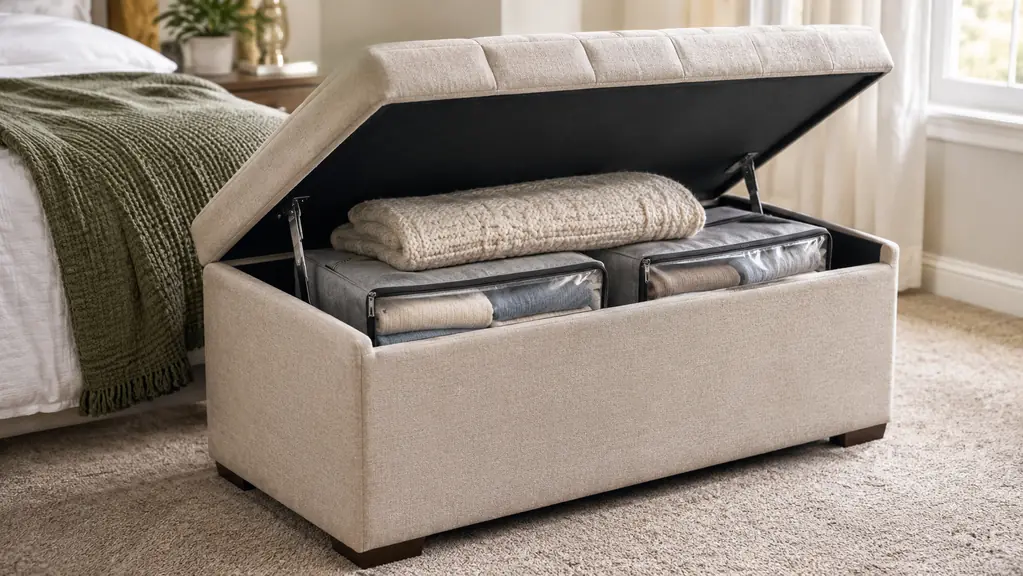
The bench does not come with dividers, and I was not about to buy a set of felt bins to go in a bench I had just bought. What I did instead cost nothing. I took two zippered pillowcases we were not using, packed the sweaters into one and the patterns into the other, and stood them on end like books on a shelf. The throw went on top, loose.
Standing things on end is the whole trick. When a bag lies flat, you unstack everything to reach the bottom of it, and by week three you stop bothering. When it stands up, you lift the lid and read the room. Gary teased me for saying that out loud, but he is also the one who now finds the extra blanket in ten seconds flat.
Two small habits keep the inside from turning into a landfill. I keep a cedar sachet in with the blankets, because wool that sits for months should not smell like a closet. I wipe the outside with a damp cloth every couple of weeks, which is all the fabric asks for. No polish, no special spray. And nothing heavy or sharp goes in there. It is a fabric bench, not a toolbox. The sewing machine stays on its table and the books stay on the shelf.
Step 5: Give the top a job so it does not fill up again
This is the step where most people lose the ground they gained. The lid is the first flat surface you see when you walk into the room, so it collects. In my house the bench collected folded laundry, a glass of water, and one memorable week a whole stack of sewing patterns. The bench was doing its job. The top had quietly become the chair all over again.
The fix was giving the top one small permanent job. Mine holds nothing but the outfit I plan to wear the next day, laid out flat, and the bench is where I sit to put my shoes on. That is the entire list. Anything else that lands up there gets handled before I get into bed. It takes about two minutes, and two minutes a night is a good deal less than a Saturday afternoon of sorting.
If a bare top feels too severe, one shallow tray or a single basket is plenty of styling. What I would not do is stack folded blankets up there in pretty piles like a catalog photograph. That is a picture, not a life, and you will be lifting six blankets every time you want the one on the bottom. The first week is the real test. I gave myself two weeks of clearing that top every night before bed, and somewhere in the second week it stopped feeling like a chore and started feeling like straightening a picture frame on the wall. Small motions, done often.
What Else Helps
A bench will hold what you give it, but clutter usually has more than one source, and a few small things made the rest of the house easier while I was at it. I keep a lidded basket on the lower shelf of the side table beside the sofa for remote controls, and the same idea works in a bedroom, one basket for the small things that never had a home so they stop landing on the dresser. The floor lamp in my living room corner taught me a related lesson: one piece that solves a real problem is worth more than three that solve a pretend one. If you are still deciding whether a bench deserves the floor space, it may help to read how mine has held up over months of daily use, or how it stacks up against a wooden storage bench before you spend anything.
One more thing worth saying: a bench at the foot of the bed changes how the room reads, not just how it works. Ours gave the bed a finished foot, the way a rug gives a room a floor. I did not expect that, and it is the reason I stopped rearranging that particular room every season. When a piece is doing two jobs well, you leave it alone.
Last practical note. If you share the room with someone, agree on what the bench is for before the first blanket goes in. Gary assumed it was for shoes. I assumed it was for blankets and sweaters. We settled it in about four minutes, and the bench has not been a source of argument since, which is more than I can say for the hall closet we used to fight over.
Sort the pile first, then buy the bench
The SONGMICS folding storage ottoman bench is 43 inches wide, 15 inches deep and 15 inches high, with 31.7 gallons inside and a lid rated to hold 660 lb. It holds a throw, four sweaters and the shoes you trip over every morning, and it opens out with no tools.
Amazon Check Today's Price on Amazon →